
For Engineering & Fabrication Workshops in South Africa
Your Machines Can’t Stop Mid-Job.
Eskom’s Load Shedding Schedule Doesn’t Care.
Lock your workshop’s electricity at R1.20/kWh for 25 years — with a solar-plus-storage system engineered for your production load, not a residential estimate.
The Problem
Every Year Eskom Takes More. Engineering Workshops Have No Margins Left to Absorb It.
You can renegotiate supplier terms, delay capex, or cut overtime. Those are choices.
You cannot stop a CNC machine mid-operation, power down a welding bay during a live job, or let compressed air fail while a hydraulic press is cycling. Your production floor requires uninterrupted power or you lose the job and the material.
And that’s exactly what Eskom is counting on.
Eskom tariffs have risen over 500% since 2008 — and the trajectory is still upward. For power-intensive operations like welding, plasma cutting, and CNC machining, electricity is not a minor overhead — it’s a core input cost. Every tariff increase cuts directly into your quoted margins.
Your heaviest equipment — lathes, compressors, arc welders, surface grinders — cannot be turned off mid-production. A load shedding cut during a precision machining run means scrap material, rework time, and a delivery failure. The cost of one interrupted production run can exceed R50,000 in material and rework.
Load shedding is a direct production loss — every hour offline is an hour you can’t bill. At Stage 4, that’s 10+ hours of potential downtime per day. For a workshop billing R8,000–R15,000 per machine hour, that’s a significant revenue exposure every time Eskom cuts.
Demand charges penalise you for startup surges — and machine startups are unavoidable. Every large motor start draws 5–8x its running current. Eskom’s demand tariff structure means you’re paying a premium on your peak draw regardless of how briefly it lasts.
Electricity uncertainty makes quoting jobs harder every year. When your energy input cost moves unpredictably, your quoted rates either compress margins or lose you the job. A locked R1.20/kWh gives your estimating team a fixed variable for the next 25 years.
The only way out isn’t to schedule around load shedding. It’s to own your energy.
The Truth About Solar + Engineering
“Can Solar Handle the Surge Load of Heavy Industrial Equipment?”
Most workshop owners assume it can’t. That assumption is costing them hundreds of thousands of rands per year.
Heavy industrial equipment does draw high startup currents — but those surges are short-lived. Your running load, which is what your system needs to sustain over time, is far more predictable. A commercial solar system is sized around your sustained load profile, and your inverter is specified to handle the inrush. This is standard engineering, not a workaround.
LiFePO4 battery storage provides the peak current buffer your startup loads need, while the solar array handles sustained generation. Grid connection remains live as backup. During load shedding, your battery bridges the gap — your critical equipment keeps running through every stage.
A commercial solar system sized for your workshop doesn’t guess at your load — it’s engineered around your specific machine list, run cycles, and demand profile.
Commercial Sizing
Your system is designed around your exact kWh consumption profile — not a generic estimate.
Battery + Grid Backup
LiFePO4 battery storage bridges load shedding. Grid connection covers any remaining gap automatically.
13-Year Track Record
BFO Solar has installed systems on commercial and industrial facilities running 24/7 operations since 2011.
Why BFO Solar Specifically
You’ve Probably Already Received 3 Solar Quotes. Here’s Why This One Is Different.
Most commercial solar companies learned their trade on residential installations and scaled up. BFO Solar started in commercial and industrial — and stayed there.
Commercial-first, not residential-adapted. We don’t apply residential sizing rules to industrial loads. Your load profile and demand peaks are analysed before any design is drawn. Most solar companies send a sales rep. We send an engineer.
Post-installation accountability. Your monitoring dashboard isn’t just a nice-to-have — it’s how we stay accountable. If your system triggers an alert, our technical team responds. You’re not on your own after handover.
COC-certified, insurance-compliant installations. Every BFO Solar installation includes a Certificate of Compliance. Your insurance policy and financing facility require this. Not every solar company delivers it as standard.
Battery storage as standard, not an upsell. For operations where power continuity is critical, battery storage is not optional — and we design it into the system from day one, sized around your specific load shedding exposure.
13 years of SA-specific track record. South African power infrastructure, load profiles, and SARS requirements are unlike anywhere else. We’ve operated through every stage of the load shedding era. We’re not guessing — we have the data.
The BFO Commercial Process
Three Steps to Energy Independence — Built Around Your Operation
Free Site Assessment
We visit your facility, analyse your load profile, monthly spend, demand profile, and roof/ground space. You receive a detailed energy savings report — at no cost and no obligation.
Custom System Design
Our engineers design a solar-plus-storage system sized specifically for your operation. Every system includes battery backup sized to protect your critical loads through load shedding.
Certified Installation + Monitoring
BFO’s certified team installs your system with zero downtime to your operation. Post-installation, you get access to a real-time monitoring dashboard so you can always verify your critical loads are protected.
Why It Works
Everything a Commercial Operation Needs From a Solar Partner
Commercial-Grade System Sizing
We engineer your system around your actual load profile — not a residential rule of thumb.
Your critical loads never go without power.
LiFePO4 Battery Storage
Built-in battery backup sized to protect your critical operations through any load shedding stage.
Your operation stays running. Your compliance record stays clean.
R1.20/kWh Locked Rate
Your energy cost is fixed for 25 years. Eskom increases become irrelevant to your operations.
Finally, a line item you can actually budget.
Zero-Downtime Installation
Phased installation approach designed around your operation. Your business keeps running throughout.
No disruption. No operational excursions during install.
Real-Time Monitoring Dashboard
24/7 visibility of your system’s output and your operation’s power status.
Instant alerts if anything needs attention — before it becomes a problem.
COC-Certified Every Time
Every installation is carried out by certified electricians compliant with SANS standards. Your insurance and financing partners require it — we deliver it as standard.
Your compliance is covered from day one.
The Investment
“What Does a Commercial Solar System Actually Cost?”
It’s the question every business owner has but few pages answer. Here’s the honest version.
Commercial solar systems typically range from R800,000 to R5,000,000+, depending on your facility’s size, monthly consumption, and battery requirements.
That range is wide — because your load profile is unique. What we can tell you with certainty: based on current Eskom tariffs and a locked rate of R1.20/kWh, most commercial clients reach full payback within 3–5 years. After that, your energy cost is near-zero for the remaining 20+ years of the system’s life.
Typically 50–150 kWp with battery storage
Typically 150–400 kWp, larger battery banks
Custom engineered, 3-phase, multi-array
Ranges are indicative only. Your free site assessment will produce an exact specification and cost — in writing, before you commit to anything.
The People Behind Your Installation
You’re Making a 25-Year Decision. Here’s Who You’ll Be Working With.
Every commercial assessment is handled by one of our experienced team members — not a call centre.

What Our Customers Say
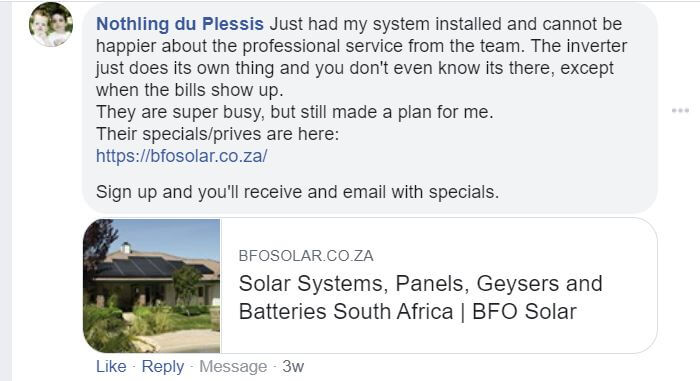
4.9 Stars Across 859+ Installations
Don’t take our word for it. Here’s what South African business and homeowners say about BFO Solar.



The Real Cost Comparison
The True 10-Year Cost: Eskom vs BFO Solar
We’re showing you both columns — including the system cost. Because a comparison that hides the capital cost isn’t a comparison, it’s a sales trick.
Eskom projections assume 8% annual tariff increase from ~R2.50/kWh. BFO Solar estimates based on system sized for 50,000 kWh/month facility. System cost depends on load profile, battery sizing, and roof access — your free assessment gives you the exact number.
Common Questions
Everything You Need to Know Before Your Assessment
Will solar handle startup surges from compressors, welders, and CNC machines?
What happens to our production floor during load shedding?
What’s the ROI for an engineering workshop?
What if there’s no sun on production days?
Is BFO Solar qualified to handle three-phase industrial installations?
Can you install without shutting down our production floor?
Ready to Lock Your Energy Costs?
We Take On a Limited Number of Commercial Assessments Each Month
Our commercial team gives every new client a detailed site assessment — not a quick quote, but a full analysis of your load profile and savings potential.
If you’re ready to lock your energy costs for the next 25 years, the next step is simple.
Here’s exactly what happens next
We call you within 4 business hours
One of our commercial assessors confirms your details and asks a few quick questions about your facility. Mon–Sat.
We visit your site within 1–2 weeks
We analyse your load profile, demand peaks, roof access, and monthly usage. No cost, no obligation.
You receive your full energy savings report within 48 hours
Exact savings projection, system specification, and ROI timeline — in writing, before you commit to anything.
✅ No obligation — ever ✅ Free site assessment ✅ Savings report in 48 hours ✅ 4.9★ rated
Our guarantee: Your energy savings report will show exact projected savings for your facility — in writing, before you commit to anything. If the numbers don’t work for you, you walk away with a free analysis of your energy costs. No pressure, no follow-up sales calls you didn’t ask for.
